 Add to Chrome
 Add to Firefox
 Add to Edge
Automatic Layer Selection for Hallucination Detection
May 27, 2026
Recent studies on hallucination detection have shown that hallucination-related signals are more strongly encoded in intermediate layers than in the final layer of large language models (LLMs). Although a growing body of work has sought to exploit this property for hallucination detection, how to automate the selection of high-performing layers remains underexplored, and principled methods for this purpose are still lacking. To address this gap, we first propose several hypotheses for why such signals emerge in intermediate layers and evaluate corresponding criteria for automatic layer selection across diverse LLM architectures, scales, and tasks, covering both question answering and summarization hallucination detection benchmarks. However, we find that none of these criteria consistently delivers satisfactory performance. We therefore propose a new selection criterion, First Effective Peak of Intrinsic Dimension (FEPoID), which consistently identify optimal or near-optimal layers and outperforms both the aforementioned criteria and existing hallucination detection baselines. FEPoID is training-free and incurs negligible computational overhead. In addition, we study the generation behaviors of LLMs and introduce a simple yet effective truncation strategy, which further amplifies hallucination-related signals and substantially improves overall detection performance. Code is publicly available at https://github.com/DesoloYw/Automatic-Layer-Selection-for-Hallucination-Detection.git

DiscoverPhysics: Benchmarking LLMs for Out-of-the-Box Scientific Thinking
May 25, 2026Frontier LLMs now perform strongly across a wide range of physics evaluations, but it is hard to disentangle genuine reasoning from recall of established science. We introduce DiscoverPhysics, an interactive benchmark that asks a LLM agent to discover the laws of motion of a simulated world whose physics deliberately deviates from our own. We construct 22 worlds governed by, among others, screened and fractional-power gravity, multi-species couplings, hidden dark-matter-like particles, non-coordinate-free physics, and time-varying interactions. Each world is generated on demand by an N-body simulator, for which the agent proposes several rounds of experiments, observes raw trajectory data, and ultimately submits both a natural-language explanation of the world's physics and a Python implementation of the inferred law. Because solving a world requires the agent to design informative experiments and revise its hypotheses, the benchmark probes long-horizon reasoning over an experimental history. We evaluate submissions along two complementary axes: trajectory MSE on held-out particles and an LLM-judged explanation score following an expert-written rubric assessing conceptual understanding of each world. Across eleven frontier models, we find that the strongest agents pass only half of the worlds and consistently fail on those where latent structure must be uncovered. Open-source models lag substantially behind commercial models, both in their ability to design informative experiments and in extracting conclusions from the data. We further find that good predictive accuracy does not guarantee high explanation quality and that conceptual understanding depends on hypothesis refinement through well-chosen experiments.
Forgetting in Language Models: Capacity, Optimization, and Self-Generated Replay
May 25, 2026Models trained on a new task typically degrade on prior tasks, a phenomenon known as forgetting. Traditionally, mitigating forgetting has required replaying stored exemplars from prior tasks, which is often impractical. By contrast, language models can sample from their own training distribution, and we show that these self-generated samples serve as effective replay data, nearly eliminating forgetting. We find that forgetting nonetheless persists when the model has little remaining capacity: models pretrained close to saturation cannot absorb new information without overwriting prior knowledge. When capacity is not the limiting factor, low learning rates reduce forgetting but require substantially more training steps. Replay breaks this tradeoff, enabling fast, high-learning-rate finetuning without forgetting.
Diverse Dictionary Learning
Apr 19, 2026Given only observational data $X = g(Z)$, where both the latent variables $Z$ and the generating process $g$ are unknown, recovering $Z$ is ill-posed without additional assumptions. Existing methods often assume linearity or rely on auxiliary supervision and functional constraints. However, such assumptions are rarely verifiable in practice, and most theoretical guarantees break down under even mild violations, leaving uncertainty about how to reliably understand the hidden world. To make identifiability actionable in the real-world scenarios, we take a complementary view: in the general settings where full identifiability is unattainable, what can still be recovered with guarantees, and what biases could be universally adopted? We introduce the problem of diverse dictionary learning to formalize this view. Specifically, we show that intersections, complements, and symmetric differences of latent variables linked to arbitrary observations, along with the latent-to-observed dependency structure, are still identifiable up to appropriate indeterminacies even without strong assumptions. These set-theoretic results can be composed using set algebra to construct structured and essential views of the hidden world, such as genus-differentia definitions. When sufficient structural diversity is present, they further imply full identifiability of all latent variables. Notably, all identifiability benefits follow from a simple inductive bias during estimation that can be readily integrated into most models. We validate the theory and demonstrate the benefits of the bias on both synthetic and real-world data.
Time-Aware Prior Fitted Networks for Zero-Shot Forecasting with Exogenous Variables
Mar 16, 2026In many time series forecasting settings, the target time series is accompanied by exogenous covariates, such as promotions and prices in retail demand; temperature in energy load; calendar and holiday indicators for traffic or sales; and grid load or fuel costs in electricity pricing. Ignoring these exogenous signals can substantially degrade forecasting accuracy, particularly when they drive spikes, discontinuities, or regime and phase changes in the target series. Most current time series foundation models (e.g., Chronos, Sundial, TimesFM, TimeMoE, TimeLLM, and LagLlama) ignore exogenous covariates and make forecasts solely from the numerical time series history, thereby limiting their performance. In this paper, we develop ApolloPFN, a prior-data fitted network (PFN) that is time-aware (unlike prior PFNs) and that natively incorporates exogenous covariates (unlike prior univariate forecasters). Our design introduces two major advances: (i) a synthetic data generation procedure tailored to resolve the failure modes that arise when tabular (non-temporal) PFNs are applied to time series; and (ii) time-aware architectural modifications that embed inductive biases needed to exploit the time series context. We demonstrate that ApolloPFN achieves state-of-the-art results across benchmarks, such as M5 and electric price forecasting, that contain exogenous information.
From Entropy to Epiplexity: Rethinking Information for Computationally Bounded Intelligence
Jan 06, 2026Can we learn more from data than existed in the generating process itself? Can new and useful information be constructed from merely applying deterministic transformations to existing data? Can the learnable content in data be evaluated without considering a downstream task? On these questions, Shannon information and Kolmogorov complexity come up nearly empty-handed, in part because they assume observers with unlimited computational capacity and fail to target the useful information content. In this work, we identify and exemplify three seeming paradoxes in information theory: (1) information cannot be increased by deterministic transformations; (2) information is independent of the order of data; (3) likelihood modeling is merely distribution matching. To shed light on the tension between these results and modern practice, and to quantify the value of data, we introduce epiplexity, a formalization of information capturing what computationally bounded observers can learn from data. Epiplexity captures the structural content in data while excluding time-bounded entropy, the random unpredictable content exemplified by pseudorandom number generators and chaotic dynamical systems. With these concepts, we demonstrate how information can be created with computation, how it depends on the ordering of the data, and how likelihood modeling can produce more complex programs than present in the data generating process itself. We also present practical procedures to estimate epiplexity which we show capture differences across data sources, track with downstream performance, and highlight dataset interventions that improve out-of-distribution generalization. In contrast to principles of model selection, epiplexity provides a theoretical foundation for data selection, guiding how to select, generate, or transform data for learning systems.
A Unification of Discrete, Gaussian, and Simplicial Diffusion
Dec 17, 2025To model discrete sequences such as DNA, proteins, and language using diffusion, practitioners must choose between three major methods: diffusion in discrete space, Gaussian diffusion in Euclidean space, or diffusion on the simplex. Despite their shared goal, these models have disparate algorithms, theoretical structures, and tradeoffs: discrete diffusion has the most natural domain, Gaussian diffusion has more mature algorithms, and diffusion on the simplex in principle combines the strengths of the other two but in practice suffers from a numerically unstable stochastic processes. Ideally we could see each of these models as instances of the same underlying framework, and enable practitioners to switch between models for downstream applications. However previous theories have only considered connections in special cases. Here we build a theory unifying all three methods of discrete diffusion as different parameterizations of the same underlying process: the Wright-Fisher population genetics model. In particular, we find simplicial and Gaussian diffusion as two large-population limits. Our theory formally connects the likelihoods and hyperparameters of these models and leverages decades of mathematical genetics literature to unlock stable simplicial diffusion. Finally, we relieve the practitioner of balancing model trade-offs by demonstrating it is possible to train a single model that can perform diffusion in any of these three domains at test time. Our experiments show that Wright-Fisher simplicial diffusion is more stable and outperforms previous simplicial diffusion models on conditional DNA generation. We also show that we can train models on multiple domains at once that are competitive with models trained on any individual domain.
The Forecast Critic: Leveraging Large Language Models for Poor Forecast Identification
Dec 12, 2025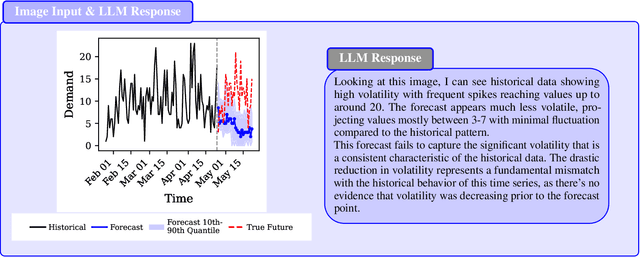
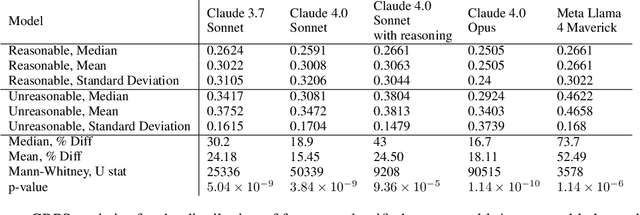
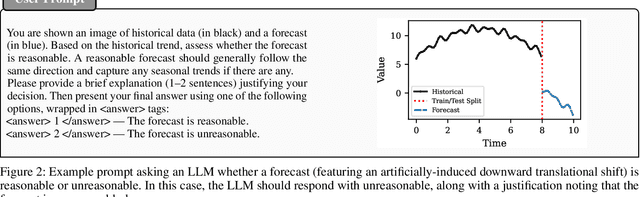
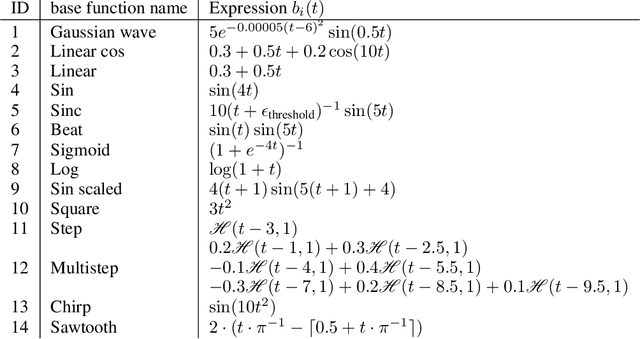
Monitoring forecasting systems is critical for customer satisfaction, profitability, and operational efficiency in large-scale retail businesses. We propose The Forecast Critic, a system that leverages Large Language Models (LLMs) for automated forecast monitoring, taking advantage of their broad world knowledge and strong ``reasoning'' capabilities. As a prerequisite for this, we systematically evaluate the ability of LLMs to assess time series forecast quality, focusing on three key questions. (1) Can LLMs be deployed to perform forecast monitoring and identify obviously unreasonable forecasts? (2) Can LLMs effectively incorporate unstructured exogenous features to assess what a reasonable forecast looks like? (3) How does performance vary across model sizes and reasoning capabilities, measured across state-of-the-art LLMs? We present three experiments, including on both synthetic and real-world forecasting data. Our results show that LLMs can reliably detect and critique poor forecasts, such as those plagued by temporal misalignment, trend inconsistencies, and spike errors. The best-performing model we evaluated achieves an F1 score of 0.88, somewhat below human-level performance (F1 score: 0.97). We also demonstrate that multi-modal LLMs can effectively incorporate unstructured contextual signals to refine their assessment of the forecast. Models correctly identify missing or spurious promotional spikes when provided with historical context about past promotions (F1 score: 0.84). Lastly, we demonstrate that these techniques succeed in identifying inaccurate forecasts on the real-world M5 time series dataset, with unreasonable forecasts having an sCRPS at least 10% higher than that of reasonable forecasts. These findings suggest that LLMs, even without domain-specific fine-tuning, may provide a viable and scalable option for automated forecast monitoring and evaluation.
A Diffusion Model to Shrink Proteins While Maintaining Their Function
Nov 10, 2025Many proteins useful in modern medicine or bioengineering are challenging to make in the lab, fuse with other proteins in cells, or deliver to tissues in the body, because their sequences are too long. Shortening these sequences typically involves costly, time-consuming experimental campaigns. Ideally, we could instead use modern models of massive databases of sequences from nature to learn how to propose shrunken proteins that resemble sequences found in nature. Unfortunately, these models struggle to efficiently search the combinatorial space of all deletions, and are not trained with inductive biases to learn how to delete. To address this gap, we propose SCISOR, a novel discrete diffusion model that deletes letters from sequences to generate protein samples that resemble those found in nature. To do so, SCISOR trains a de-noiser to reverse a forward noising process that adds random insertions to natural sequences. As a generative model, SCISOR fits evolutionary sequence data competitively with previous large models. In evaluation, SCISOR achieves state-of-the-art predictions of the functional effects of deletions on ProteinGym. Finally, we use the SCISOR de-noiser to shrink long protein sequences, and show that its suggested deletions result in significantly more realistic proteins and more often preserve functional motifs than previous models of evolutionary sequences.
Understanding the Implicit Biases of Design Choices for Time Series Foundation Models
Oct 22, 2025Time series foundation models (TSFMs) are a class of potentially powerful, general-purpose tools for time series forecasting and related temporal tasks, but their behavior is strongly shaped by subtle inductive biases in their design. Rather than developing a new model and claiming that it is better than existing TSFMs, e.g., by winning on existing well-established benchmarks, our objective is to understand how the various ``knobs'' of the training process affect model quality. Using a mix of theory and controlled empirical evaluation, we identify several design choices (patch size, embedding choice, training objective, etc.) and show how they lead to implicit biases in fundamental model properties (temporal behavior, geometric structure, how aggressively or not the model regresses to the mean, etc.); and we show how these biases can be intuitive or very counterintuitive, depending on properties of the model and data. We also illustrate in a case study on outlier handling how multiple biases can interact in complex ways; and we discuss implications of our results for learning the bitter lesson and building TSFMs.